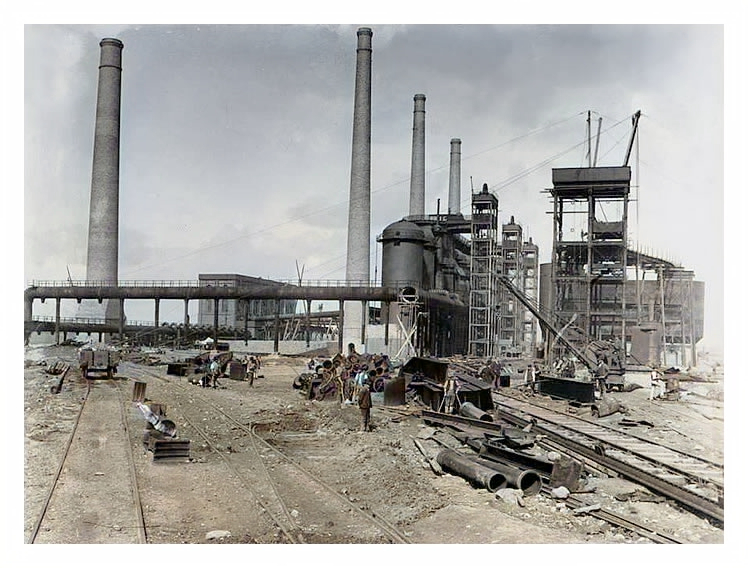
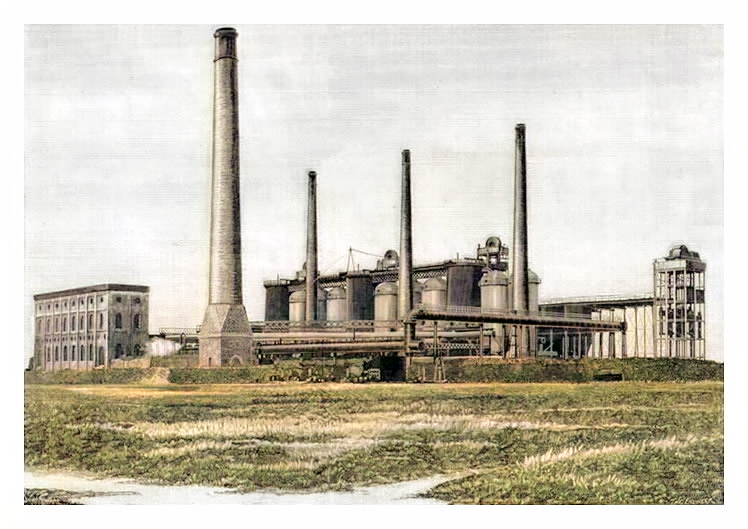
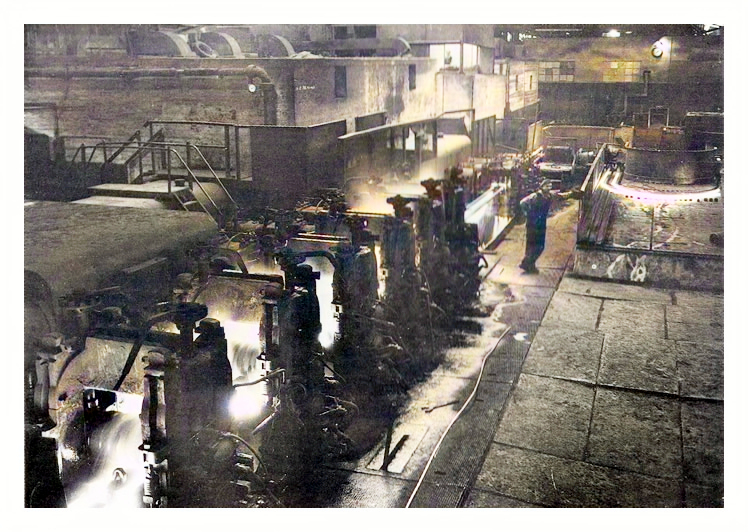
In the early 1970's I returned to south Wales for a few months and worked for a time as a shift engineering fitter on the steel rolling mills of the Castle Works of GKN, Guest, Keen and Nettlefolds which was situated on the Cardiff docklands, nearby "Tiger Bay". Steel ingots were brought directly from the Dowlais steel works next door for hot rolling into sections such as concrete reinforcement "rebar" which were still red hot and traveling at around 60 miles per hour by the time they reached the end of the mill. I colourised the above images just to add a little sense of the ever-present danger experienced by workers at the works.
The images above [1387] date from the 1960's and are of the continuous hot-rolling mill and its double ended layout complete with three loops or repeaters as they were known. As the steel was rolled by being passed through successive sets of two-high rollers, the section becomes reduced but the linear speed of rolling increases. If one of the sets of rollers was not at the correct speed a "cobble" occurred which usually resulted in red hot steel shooting upwards and outwards with unpredictable speed and direction!
On my first nightshift there, I witnessed an accident when the roller-man lost his arm as a cobble landed on him. Only a little blood and just the hint of a good kebab cooking!
The plant was showing its vintage when I worked there since the hot-rolling mill had been installed c.1935 by the Morgan Company of America. It was one of the first rod mills in the UK where the rod was guided without the need for operators using tongs by hand - this being a rather more dangerous adventure altogether!
A new mill was under construction which had twice the capacity and speed and I was earmarked for employment there when I got the call to return to the West Riding of Yorkshire and play soprano cornet with the John Foster and Sons, Black Dyke Mills Brass Band in Queensbury. So no more steel just blowing my own trumpet and maintaining yarn winding machines for making high quality cloth - it was like walking back 100 years!