|
|
Penarth Dock, South Wales - the heritage & legacy . . . |
|
|
Penarth Dock, South Wales - the heritage & legacy . . . |
 |
|||||
 |
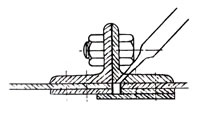
Volume Three - The Pontoon Era - Notes on the longitudinal joint of the Penarth dock . . . When in Penarth basin, the Dock would be coupled to the shore columns, steam got up, and the Dock sunk until the extension piece floated off, it being previously ballasted with kentledge or pig iron to make it float at the desired level. The Dock would then be raised to the desired point, the extension piece brought alongside, and coupled up along its top edge. Joint packing. India rubber has generally been used for this purpose, but in a permanent joint like the present one, it is doubtful if something more lasting than rubber should not be used. Rubber undoubtedly perishes, although very slowly, in water, but whilst perishing the sulphur seems to attack the iron, and forms a compound which appears durable, although it has lost all elastic nature. Something might perhaps be done with rope gaskets thoroughly impregnated with gutta percha and oxidised oil. Some years ago, the writer experimented in coating string with a mixture of oxidised oil, and gutta and cork dust, and different colouring materials, with the idea of weaving the same together to form a linoleum. It was found that so much gutta was required to get the mixture to hang onto the string, that the expense became prohibitive. Something of the sort might, however, be made for this Dock, and as the packing need only be put in place half an hour before the joint is made, the packing might be soft and weak, as there would be no danger of its coming out of the joint recess. In fact, possibly a spun yarn gasket well covered with red and white lead might do.
|
||||
| Introduction | |||||
| Contents | |||||
| Search this site | |||||
| Contributions | |||||
| Links | |||||
| Recent Updates | |||||
|
|||||
| | volume 03 | chapter 02 | page 03 | << previous page << | index to volume three | >> next page >> | | |||||
|
|||||