|
|
Penarth Dock, South Wales - the heritage & legacy . . . |
|
|
Penarth Dock, South Wales - the heritage & legacy . . . |
 |
|||||
 |
Volume Six - Pre-Victorian to the Present Day - Select Aspects - The Penarth Harbour Dock and Railway - Railway World Article - 1964 . . . I lived in a house overlooking Grangetown Junction from 1941 to 1935. Since then I have used the house for regular business visits to Cardiff and have witnessed the rise, decline and fall of Penarth Dock. I have thus had a continuous picture of activity on the Penarth line for 50 years. It is interesting to look back on the scene in the pre-grouping days, when there was a continuous procession of coal trains through Grangetown and in addition to the intense activity at Llandough sidings and Penarth Dock there were always half-a-dozen engines working on the harbour line. Coal trains on trip workings from the nearer sidings to the docks or harbour line rarely used brake-vans; the guard usually rode on the buffer of the last truck with a red flag or lamp attached to the coupling hook. The activity went on day and night and after the city noises had subsided at night there was always a continuous orchestra of locomotive whistles and ship's sirens to be heard.
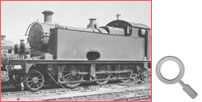
The engine was usually a Taff Vale N, 0-6-2T or L, 0-6-0T. The same feat was performed by a W.R. pannier tank a few years ago, but most recent workings on the harbour line have been by diesel shunters, one of which was kept permanently in the shunting spur at Grangetown Junction. Penarth Dock engine shed kept a fair assortment of Taff engines and all classes worked on the dock and harbour line, except the Class A, 0-6-2T, which were kept on passenger work. The usual shunters were the V class 0-6-0 saddle tanks, very similar to the L.Y.R. engines that lasted until recently, but the V's were gone by 1930. Engines noted at Penarth Dock shed in 1928 were; (ex T.V.) 8 Class A, 0-6-2T's, 2 Class M1. 0-6-2T's, 2 Class 0-6-0ST's; and 5 ex-Barry Railway 0-6-0ST's and 4, 0-6-2 T's. The shed was closed a few years afterwards and all the engines transferred to the ex-Barry Railway shed at Barry Town. All classes of Barry engines passed Grangetown. Their large 0-8-2 and 0-6-4 tanks worked through Cardiff to collect coal traffic from Rogerstone sidings north of Newport by arrangement with the G.W.R. Their 2-4-2 tanks headed most passenger trains and were very smartly turned out in red-brown, with copper-capped chimneys and brass dome covers shinning beautifully. Cardiff-Barry trains were either ten six-wheelers or (later) seven bogie coaches. |
||||
| Introduction | |||||
| Contents | |||||
| Search this site | |||||
| Contributions | |||||
| Links | |||||
| Recent Updates | |||||
|
|||||
| | volume 06 | chapter 07 | page 09 | << previous page << | index to volume six | >> next page >> | | |||||
|
|||||