|
|
Penarth Dock, South Wales - the heritage & legacy . . . |
|
|
Penarth Dock, South Wales - the heritage & legacy . . . |
 |
|||||
 |
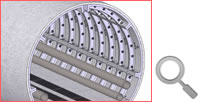
Volume Six - Pre-Victorian to the Present Day - Select Aspects - Structural Analysis of the river Ely Subway by Rota Design Limited - 2015 When in 1991 Brian Colquhoun & Partners surveyed the subway under the river Ely they produced detailed drawings of the original tried and tested design dating from the 1890's. We at Rota Design Limited are fascinated by the subway and needed to understand how the subway had survived the loadings applied to it during the 115 years since it was formally opened. So we decided to undertake some analysis upon it as a heritage research project and gave the task to a young talented engineer named Josh. The first thing he had to consider is that the subway is subjected to loading from the mass of the clays and gravel layers through which it was tunneled and in addition from the cyclical pressure of the rise and fall of tidal waters above it which admittedly has only occurred just over 84,000 times so far in its lifetime! Take a thin piece of steel and flex it back and forth a few times - well unless it is spring steel and well tempered it will fail after a short time! The subway was constructed from cast iron segments. Cast iron, unlike many other metals, doesn't take too kindly to bending or being subjected to tensile forces (stretching) but it performs well when it is being squished. that is under compression. An example would be a column supporting a bridge or the Eiffel Tower.
Again, just consider your thin piece of steel. Bend it and one surface is stretched, that is, it is tension at the same moment the opposite surface is in compression. Somewhere along its mid-thickness there is a neutral plane where it is neither in tension or compression. But this is what happens to all structures when they have forces applied to them. Another principal to think about is to consider our subway as an empty lemonade or coke can. Squeeze it gently in your hand and release - it regains its original circular shape. Squeeze it now like you would hug someone if you had just checked your numbers and found that you had won the lottery! It collapses and will not return to its original shape. It has buckled under the load, its geometry has changed forever and you have probably changed the characteristics of the material as well! This, incidentally, a common failure mode for pipes and chambers buried under the ground. |
||||
| Introduction | |||||
| Contents | |||||
| Search this site | |||||
| Contributions | |||||
| Links | |||||
| Recent Updates | |||||
|
|||||
| | volume 06 | chapter 17 | page 010 | << previous page << | index to volume six | >> next page >> | | |||||
|
|||||