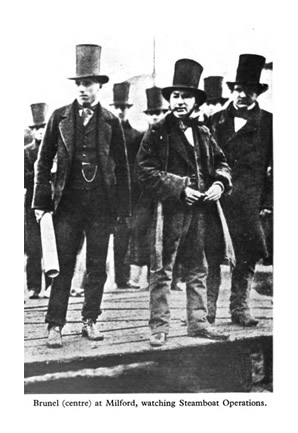
1859 Brunel suffered a stroke, just before the SS Great Eastern made her first voyage to New York. He died ten days later at the age of 53 and was buried, like his father, in Kensal Green Cemetery in London. He left behind his wife Mary and three children: Henry Marc Brunel (1842–1903), Isambard Brunel, Junior (1837–1902) who went in to Law, and Florence Mary Brunel (c.1847–1876). Henry Marc enjoyed some success as a civil engineer.
Many of Brunel's original papers and designs were gathered in the Brunel Collection at the University of Bristol. The collection has now been moved to the new Brunel Institute, a joint project of the University and the SS Great Britain Trust.' [016]
1843 - Mr. Brunel. - 'The loss of this eminent engineer has been threatened us, but we are delighted to say that sanguine hopes of his early recovery may be entertained. It appears that while endeavouring to amuse his own or some friend's children, by pretending to pass money from his mouth to his ear, he slipped a half-sovereign, which stuck in his trachea, and the danger to his life has in consequence been most imminent for several days.' - The Builder Vol. 1 [461] 13th May 1843. [20170810]
1843 - Mr. Brunel. - 'It was on Saturday night that the intelligence fell in our way that all was safe, as regarded the late peril to the life of this eminent engineer, and we threw up our hands to God immediately. It was truly appalling to think of the sacrifice of a valuable life in such a manner, and in playing with children too ! but the shield of the innocent has been thrown over him, and we trust he may live many years to the pleasure of his own family circle, and the distinguished ornament of his profession.' - The Builder Vol. 1 [461] 20th May 1843. [20170810]
1838 - 'Though an able and ingenious man, Brunel himself has no experience in railways and seems to hold in slight regard the judgment of those who have.' - The Railway Times [982] 1838.
1845 - 'We do not take him for a rogue or a fool but an enthusiast, blinded by the light of his own genius, an engineering knight-errant, always on the lookout for magic caves to be penetrated and enchanted rivers to be crossed ; never so happy as when engaged "regardless of cost" in conquering some (to ordinary mortals) impossibility.' - The Railway Times [982] 1845.