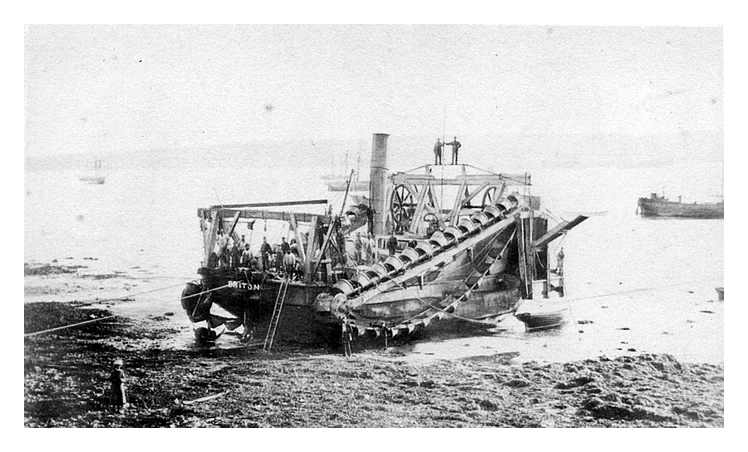
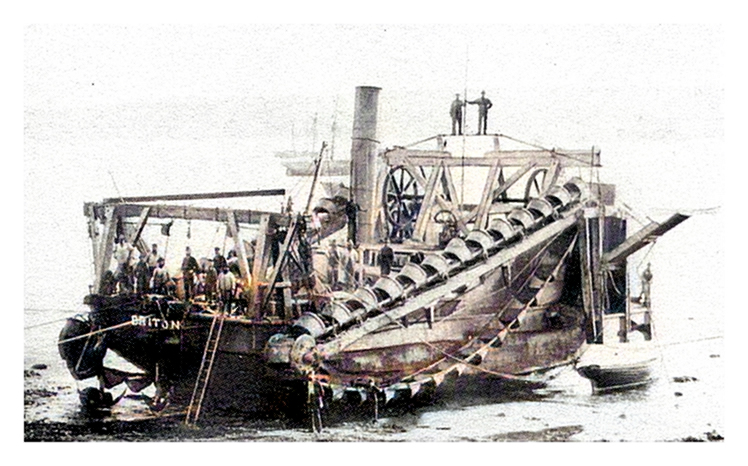
Mr. Mitchell's powerful dredging machine in 1863 complete with its two sets of 31 buckets connected by a system of iron links guided on the 'ladders'. The bow is facing towards us and is complete with two anchors. A heavy duty wooden gantry at the bow has a rope system to lower each 'ladder' independently to the optimum dredging depth. A single rope passes from a winch through a multiple sheave block system in order to gain mechanical advantage. The end of this rope is attached to an iron yoke which in turn has a chain attached to each side of the 'ladder'. The 'Briton' has a propeller to move it forward whilst the buckets scoop up the mud and shale from the river bed. At the top of its lift, the spoil is deposited down a wooden chute and into an awaiting tender or barge, one moored at each side. The buckets obviously tip at the upper drive end sprocket and are therefore self-emptying.
The chain-links connect the buckets together and maintain their correct orientation. The drive sprocket mounted at the stern is attached to a half-shaft onto which is installed a large sheave. I can't quite make out the mechanism here but it would appear to be a flat belt drive from the port and starboard sheaves into the engine room below. Alternatively it could be a chain drive. I could imagine that this drive mechanism would have received considerable shock loadings as it dredged-up mud, shale and rocks, so perhaps a belt-drive would be more appropriate for the application.
The helm can be made out clearly amidships for steering the boat. The operation would have left the river bed with two excavated grooves so it would have been necessary to make a number of parallel runs in order to evenly level the river bed. I can imagine that the helmsman would have felt a great deal of influence upon the wheel from the constantly varying depth and density of dredge on the port and starboard sides combined with the influence of tidal flow and wind. I would have said that he (or she) was a highly skilled person to get the job done and I am in awe of their amazing feats.
The crew pose for the photographer and await the tide to continue their work. I can count about 17 men and boys and one lady admirer waiting on the shore. I believe the photo was taken at Falmouth but I would like to have verification of this statement - can anyone assist with further information about this wonderful piece of British engineering. The general layout is similar to the design of 'modern' bucket dredgers which continued in service within UK coastal waters and estuaries until 1992. They were truly enlightened pioneering engineers - no wonder they named it 'Briton'. Bravo Mr. Mitchell! The enlargement has been colourised. [323]