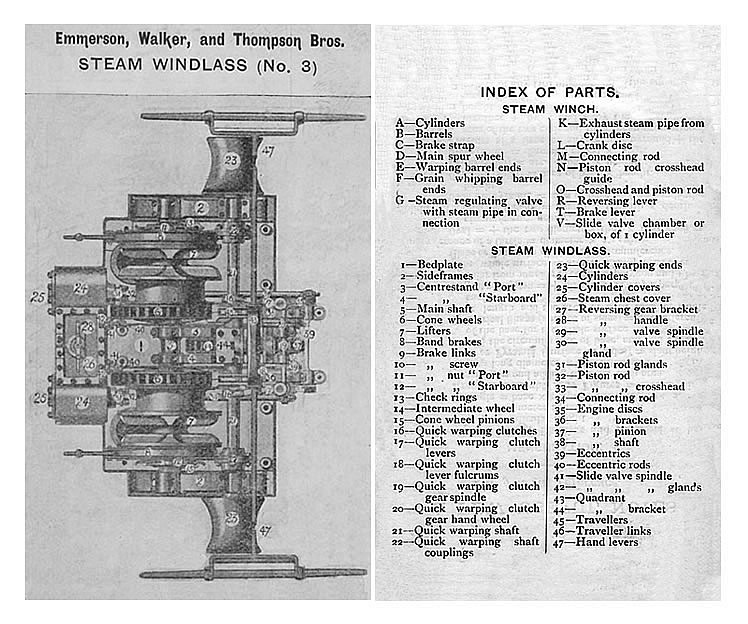
An illustration of a Steam Winch and a Number 3 Steam Windlass manufactured by Emmerson, Walker, and Thompson Bros. of Dunston in County Durham. The company was founded in 1870 and had a number of patents for windlass designs. Note the complexity of just one of the basic items of equipment of which a steam ship had numerous such devices. The shipwrights and engineers had to gain knowledge and functional understanding of many such devices as well as having the skills to repair and maintain these vital pieces of equipment. The illustrations are from C. H. Bailey's Book of Useful Information, Price 7/6d. [001] [234]
The windlass is normally used for lifting the anchor by its chain whereas the winch is used for pulling rope by looping it around the 'warping ends' or by attaching the end to the main barrel in the case of heavier loads. Some windlass designs had a dual purpose facility such as the one illustrated above.
For the first weeks of my apprenticeship at the Penarth Dock Engineering Company I had to learn some basic skills of fitting using only hand tools such as a hammer, cold chisel, hacksaw and hand files to shape a square block from round bar and then fit it to a square hole in a steel plate with no greater clearance than a few 'thou' (0.001 inch). Why? Why, Oh Why? I asked Mr. Smith, 'because lad' he started to explain ; 'I was once the engineer on board a ship sailing home across the Indian Ocean. The ship lost speed but the engines were still revolving. So, I inspected the propellor shaft only to find that the main drive keyway and couplings had somehow become damaged. So the only thing for it is to cut a new keyway in the prop shaft at 180 degrees to the old one; no machines to help, just a hammer, cold chisel, files and 'britches-arse-steam'. After you have missed a few times with the hammer because you are sweating profusely in the heat and access is limited, the first mate come down and says that there is a tropical storm heading our way! The pain from the 'loss of bark' on the hands and knuckles disappears and its head down to cut the keyway PDQ (pretty damn quick). Then shape and fit a new gibhead key, hammer it home, and fingers crossed as the prop shaft slowly starts to rotate, that you have done a good enough repair to get you home!' - Oh, I fully understand now Mr. Smith and thank you for taking the time and trouble to explain to me, I said using the appropriate engineering vernacular!