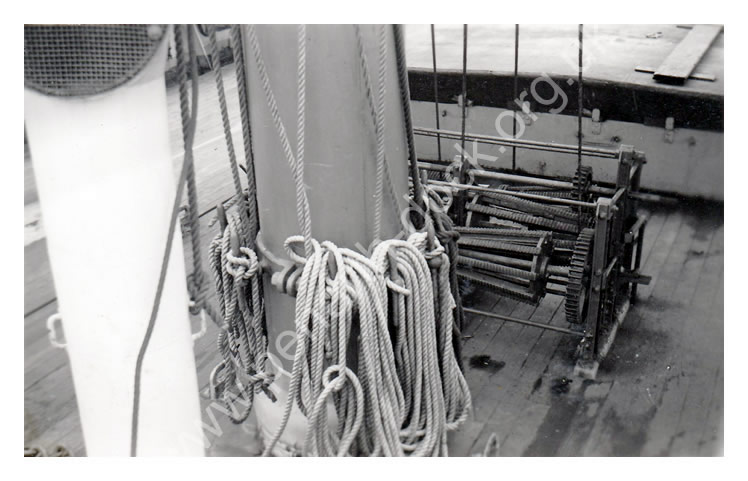
'Pamir' - ''The Jigger Bitts'. [001]
My 'Young Sea Officer's Sheet Anchor or a Key to the Leading of Rigging and Practical Seamanship' by Darcy Lever [336] and originally published in 1819 states that a Bitt is:-
'The Bitts are used for receiving a Turn of the cable and bearing a great portion of the strain upon the cable which the ship rides by together with the Stoppers'.
In the foreground is a ventilator which is the subject of one of William Stark's [336] stories from his voyage around the Horn in 1949:-
'The ship rolled in the seas and when it was over the chief steward reported that a great deal of seawater was sloshing back and forth in the provisions storeroom. This caused much alarm and rumour and activity onboard the Pamir. The provisions storeroom lay 'tween decks - the thin storage space covering the whole ship was sandwiched between the deck itself and the hold. The seawater sloshing about in it suggested that the Pamir's hull had sprung a leak and water somehow poured into the ship whenever she rolled on her side. This was very bad news for a windjammer about to enter the Roaring Forties. Even with a relatively small leak, if the barley (cargo) dampened it could swell and with tremendous pressure burst open the steel plates of the hull.
The officers hastily dispatched teams of sailors equipped with flashlights to crawl like packs of rats over the bags of grain in the Pamir's hugh, dark hold, searching for leaks, while others bailed out the storeroom. Two days of searching turned up nothing. Finally, someone noticed that one of the ventilators on deck - one of the big tuba-shaped pipes that carry fresh air belowdeck - faced forward instead of aft. This meant that a sea had broken over the deck of the Pamir during the squall, the ventilator had funneled seawater down into the storeroom. This accounted for the alleged 'leak' in the Pamir's hull and it was fixed simply by turning the ventilator around until its openeing faced aft.'