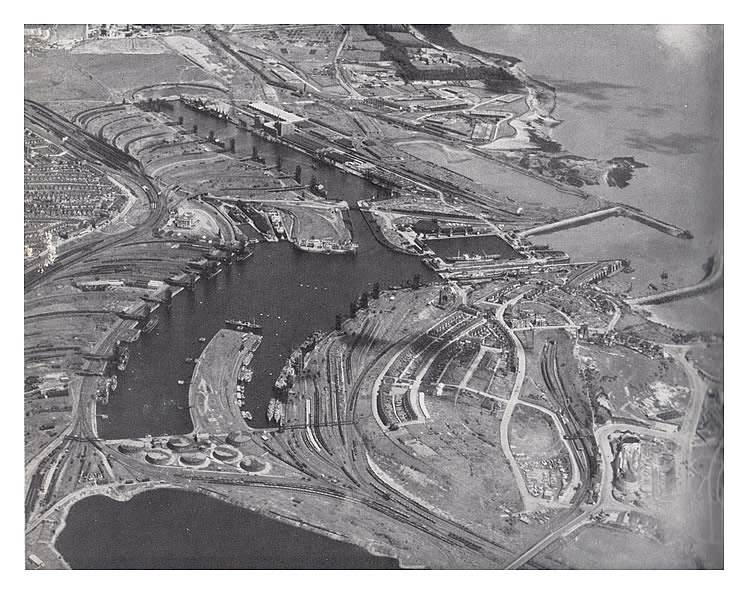
An Aerial view of Barry Docks. No. 1 Dock is centre foreground. No. 3 (Basin) centre right and No. 2 Dock at top. A photograph taken from the book 'South Wales Ports' published by the Transport Commission in 1948.
It states that:- 'The growth of Barry as a town and seaport is of comparative recent history and may be regarded as an outstanding example in the industrial development of South Wales. Until the 1880's there existed nothing larger than a village of less than 100 inhabitants, but the construction of a series of docks quickly led to an influx of workers, to such an extent that the town now has population approaching 40,000.
It is not difficult to understand, therefore, that historical references to the place are few and far between. It is known that a castle existed in the vicinity, probably built during in the 13th century, but destroyed in 1402 by Owain Glyndwr during an excursion of plunder and destruction in South Glamorgan. In any event, all that remains is an ivy-clad gateway and portcullis chamber.
In the 18th century, Barry Island had the unenviable reputation of being one of the principal hiding places in the Bristol Channel for pirates and smugglers. It became a miniature fortress and it was only after considerable efforts on the part of the Customs Authorities that it was cleared of its occupants. Now, it is one of the most popular seaside resorts in the Channel.' [203]