Penarth Dock, South Wales - 150 years - the heritage and legacy  
Penarth Dock, South Wales - the heritage & legacy . . .

Volume Eight - Pre-Victorian to the present day - more aspects - George Wehrley - Photographer . . .

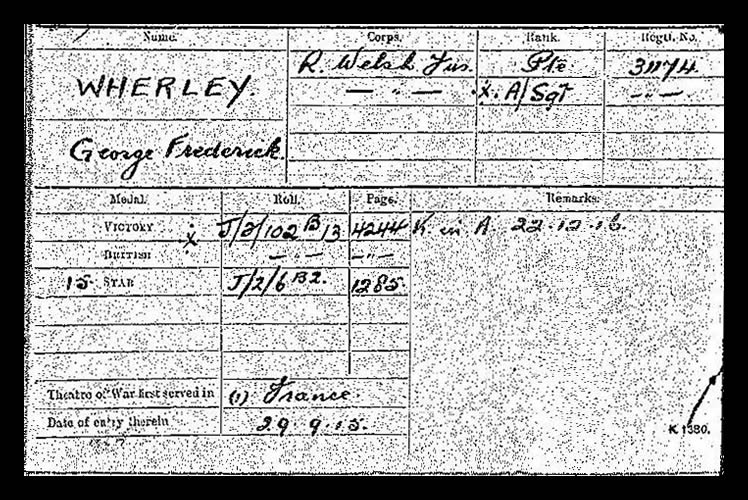
Medal card of Wherley, George Frederick Corps: Royal Welsh Fusiliers Regiment.

Medal card of Wherley, George Frederick - Corps: Royal Welsh Fusiliers Regiment - The total number of men conscripted into the British Armed Forces during the First World War was 2,277,623. 280,000 Welshmen served and approximately 35,000 of them died, almost 11,000 of which were Royal Welsh Fusiliers. George was awarded the Victory Medal, the British Medal and 15 Star Medal.

The 1914–15 Star was never awarded singly and recipients were also awarded the British War Medal and Victory Medal. The three medals were sometimes irreverently referred to as Pip, Squeak and Wilfred after three comic strip characters, a dog, a penguin and a rabbit, which were popular in the immediate post-war era. Pip represented either of the two Stars, Squeak represented the British War Medal and Wilfred represented the Victory Medal.

The above document is held within the National Archives [Archive Reference : WO 372/21/108068] [142]



The following medals were awarded to George Frederick Wherley.

Many thanks to the website 'The Great War 1914 - 1918' for the following information and accompanying images borrowed from 'A Guide to British Campaign Medals of WW1.' [826]

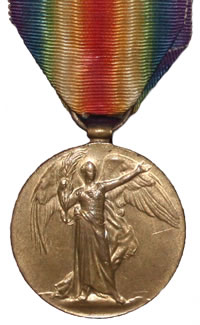
The Allied Victory Medal.

The Allied Victory Medal - Also known as 'Wilfred'

It was decided that each of the allies should each issue their own bronze victory medal with a similar design, similar equivalent wording and identical ribbon.

The British medal was designed by W. McMillan. The front depicts a winged classical figure representing victory.

Approximately 5.7 million victory medals were issued. Interestingly, eligibility for this medal was more restrictive and not everyone who received the British War Medal ('Squeak') also received the Victory Medal ('Wilfred'). However, in general, all recipients of 'Wilfred' also received 'Squeak' and all recipients of 'Pip' also received both 'Squeak' and 'Wilfred'.

The recipient's service number, rank, name and unit was impressed on the rim.

   
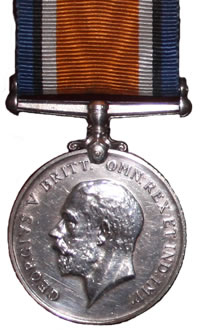
The British War Medal, 1914-18.

The British War Medal, 1914-18. - Established on 26th July 1919. Also known as 'Squeak'.

The silver or bronze medal was awarded to officers and men of the British and Imperial Forces who either entered a theatre of war or entered service overseas between 5th August 1914 and 11th November 1918 inclusive. This was later extended to services in Russia, Siberia and some other areas in 1919 and 1920.

Approximately 6.5 million British War Medals were issued. Approximately 6.4 million of these were the silver versions of this medal. Around 110,000 of a bronze version were issued mainly to Chinese, Maltese and Indian Labour Corps. The front (obv or obverse) of the medal depicts the head of George V.

The recipient's service number, rank, name and unit was impressed on the rim.

   
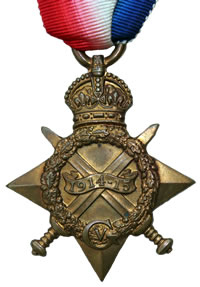
The 1914-15 Star.

The 1914-15 Star - Established in December 1918 was also known as 'Pip'.

This bronze medal was authorized in 1918. It is very similar to the 1914 Star but it was issued to a much wider range of recipients. Broadly speaking it was awarded to all who served in any theatre of war against Germany between 5th August 1914 and 31st December 1915, except those eligible for the 1914 Star. Similarly, those who received the Africa General Service Medal or the Sudan 1910 Medal were not eligible for the award.

Like the 1914 Star, the 1914-15 Star was not awarded alone. The recipient had to have received the British War Medal and the Victory Medal. The reverse is plain with the recipient's service number, rank, name and unit impressed on it.

An estimated 2.4 million of these medals were issued.

© 2014 - 2025 - penarth-dock.org.uk - all rights reserved - web design by Dai the Rat