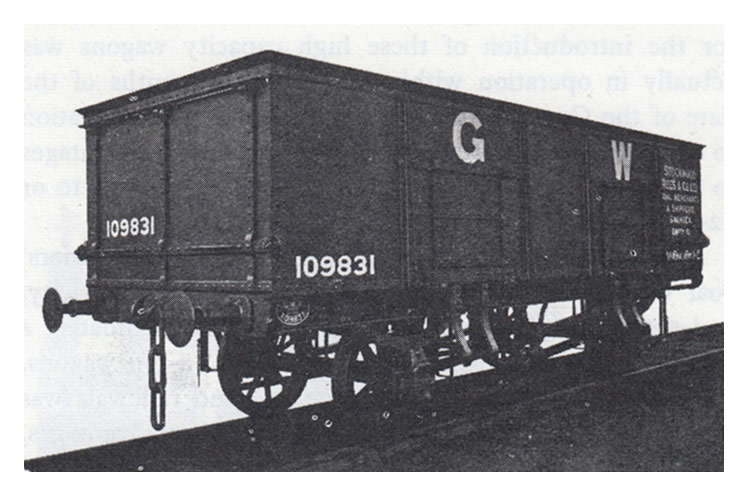
20-ton Coal Wagon - from 'Twixt Rail and Sea, published in 1927, which also states : -
'Port Talbot is another port of recent development, for practically all the docks have been built within the last thirty years. Its growth may be measured by the fact that in 1900 it dealt with half a million tons of traffic, and in 1923 with three and a quarter million tons.
It was at Port Talbot that the first 20-ton coal wagons were tipped in August, 1924, and event which marked the beginning of a new era in coal transport and shipping operations in South Wales. The 20-ton wagon was an innovation for which the Great Western Railway must take the credit. The scheme for the introduction of these high capacity wagons was actually in operation within less than six months of the date of the General Manager addressing a communication to South Wales coal traders telling them of the advantages to be gained by their adoption, in place of the old 10 or 12-ton wagons.
At that time there were about 110,000 private owners' coal wagons in South Wales, mostly 10-ton capacity, and as the 20-ton wagon can be built at approximately a saving of 50 per cent. on the cost of two 10-ton wagons, the economy in first cost, maintenance and renewals was obvious. The high-capacity wagon has other advantages, for a train of fifty 10-ton wagons measures 1,009 feet, and its capacity is, of course, 500 tons. Two such trains (1,000 tons) would have a length of 2,018 feet, but fifty of the new 20-ton wagons (conveying 1,000 tons) only occupy 1,225 feet of siding space.
You will see that there are all-round advantages to the use of 20-ton wagons, and in order to encourage their use the great Western Railway grant a rebate off the railway rate and a reduction in the tipping and weighing charges at the docks.
The introduction of the 20-ton wagon has necessitated a heavy expenditure in the construction of new hoists and other shipping appliances and the adaption of others, in order to take the larger and heavier wagons.' [473]