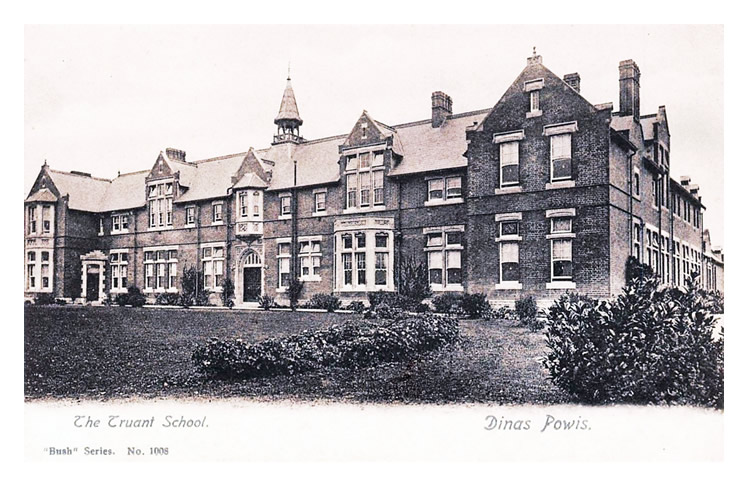
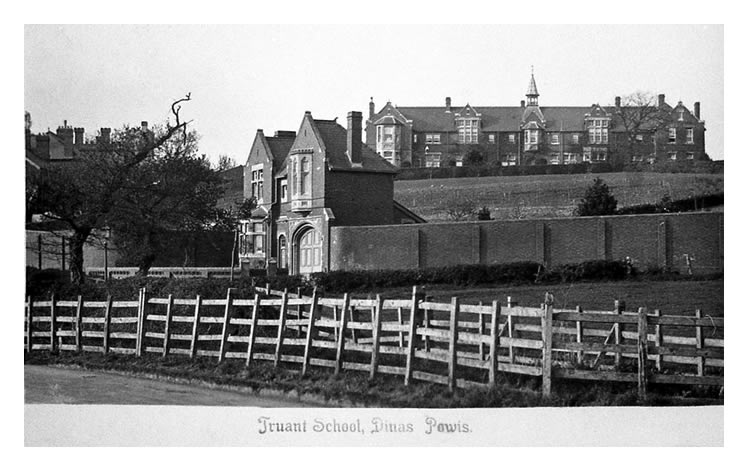
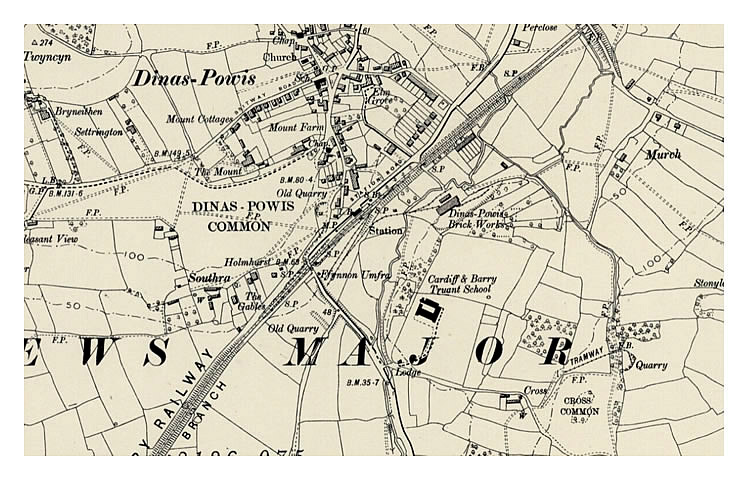
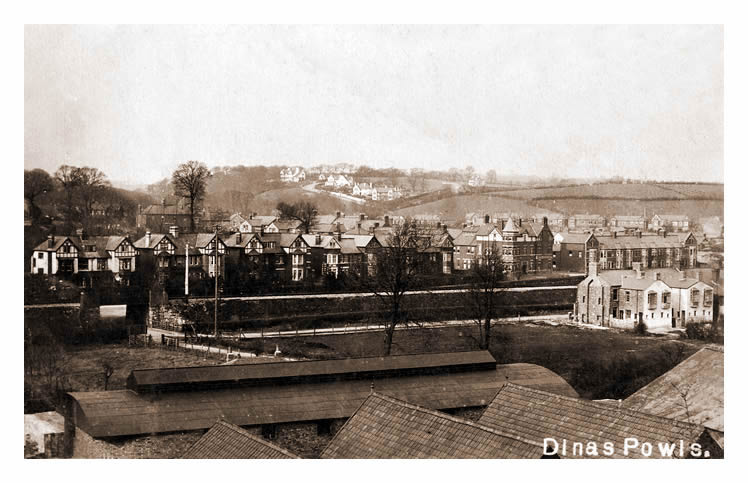
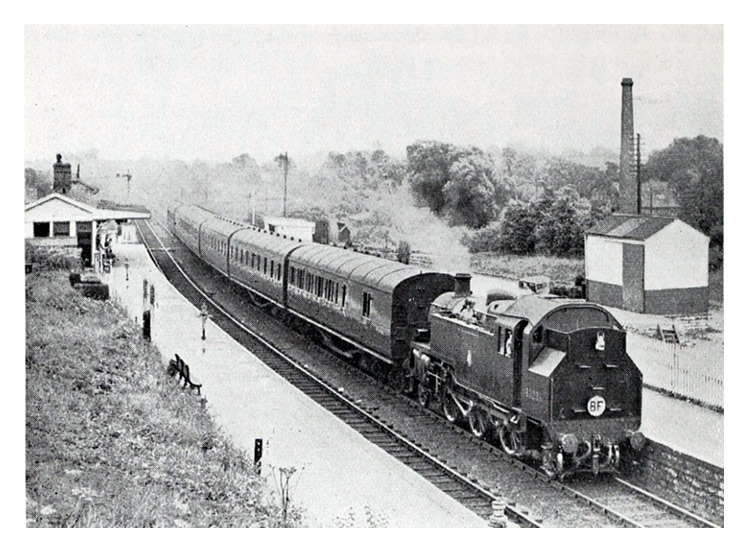
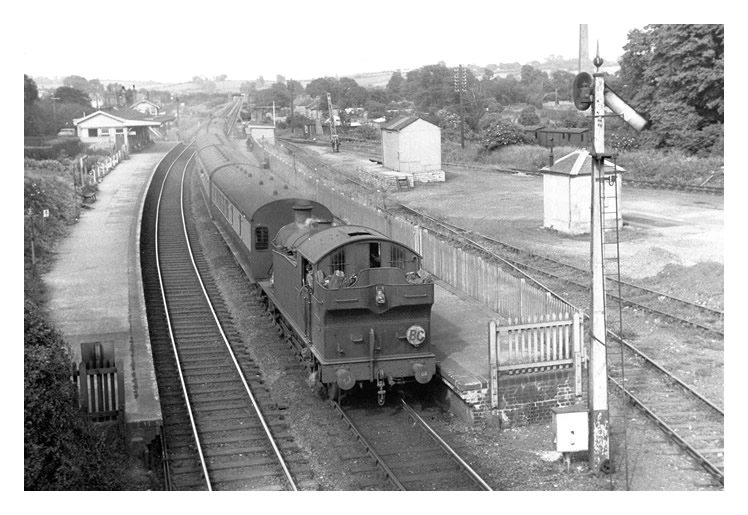
◊ 'Bryn-y-Don and Gwalia Brickworks' - An OS map published in 1901 which shows Dinas Powis Station, Cardiff & Barry Truant School, The Murch where I used to live (1952-1970), and the remnants of the Dinas Powis Brick Works which was situated adjacent to the pathway we often used from the Murch to the village or station.
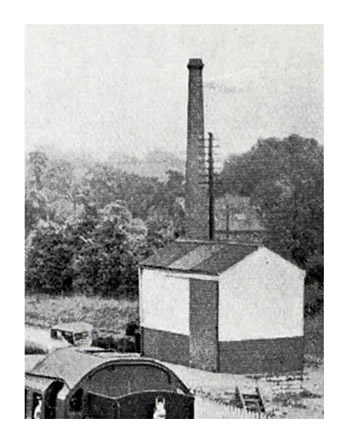
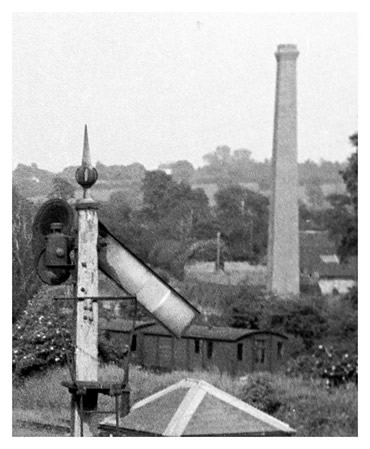
I used to ride my bicycle through the dark and spooky interior of the Hoffmann kiln which was situated nearby the Cadoxton Brook. The brickworks, formed by T. W. Booker then became Owens & Watkins who begat, Evan Owens & Company, finally becoming the Glamorgan Brick Company c.1915. The kiln apparently ceased operation sometime between the wars, i.e. 1918 to 1939, so far as I can ascertain. Next to the refractory red brick sausage shaped kiln with its partially demolished chimney, there was a large framed shed which I used to visit. This originally was the preparation area for puddling the clays from the adjacent quarry, preparation of bricks and the packaging and warehousing of the finished deep red tones of the brick from which many of the local houses were built.
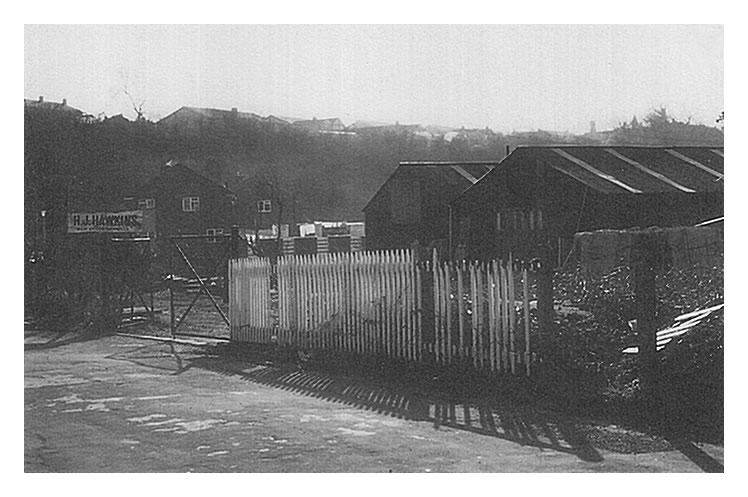
I recall that this shed of the former brickworks but had been converted to a saw-mill owned and run by Mr. Hawkins who later had a great deal of time and patience with me ; a fine gentleman indeed. The operation there involved tree sized logs inwards and mostly coffins outwards although the garden shed at Murch Road was constructed during the mid-50's by my father from mill offcuts of elm. Later, around 1957-8, the kiln and outbuildings were demolished and the saw-mill relocated adjacent to the Barry Railway line the other side of 'Marble Arch' (as the Western Welsh drivers and conductors named it!). Proceeding under the railway bridge, on the left is the entrance to Elmgrove Place (originally named Brickyard Row) and straight onwards we reach an old concrete bridge over the Cadoxton Brook, the entrance to the site of the brickyard. Who can remember the WWII bomb shelters in Elmgrove Place? - I used to play inside them with my friends from Dinas Powis Primary School.
When I was a little older, I worked at the saw-mill on Saturday mornings for Mr. Hawkins in return for a few bob (shillings) pocket money and soon learnt how to splice flat belt drives using crocodile clips as well as being taught to operate the machines and drive the cranes to load the timber onto the machine bed. The Health & Safety at Work Act was over a decade in the future and guarding of the moving parts of the machinery was minimal! The flat leather drive belts drove the horizontal saw blade back and forth whilst a large cast iron table, onto which the log was secured, inched forward through the main saw plant, cutting the logs, through and through, and yielding planks about ¾ of an inch thick. Occasionally, the blade would be jammed by some object within the timber and this was usually meant that a hammer, some steel wedges and a cold chisel was required to free it up and remove usually a particle of steel from the log. On a few occasions that I witnessed, the offending article was a bullet and Mr. Hawkins had amassed a collection of spent ammunition plus, in one corner of the shed, a pile of scrap blades which were minus a few teeth!
The toilet facilities at the saw-mill consisted of a large white, chipped-enamel, bucket over which you placed two short planks which, after each use, had to be emptied into Cadoxton Brook whilst no one was looking! The toilet paper was not that soft stuff you have today but newspaper which was my job to cut up into squares, pierce a hole through the corner and then thread some string through to hang it up on - ah sheer luxury! So, you read it, did the crossword, ate your fish and chips out of it and wiped your bum with it as well in those days! Oh, and it was used to polish car windscreens and light your coal fires at home as well. It was truly a really useful, multi-purpose, product!!
The quarry site is now a housing estate but the quarry used to extend through to a deep lake which in summer months was covered by a thin 'skin' over which, I shiver to think, my friends and myself played upon. We watched numerous newts swim about ; we were 'attacked' by dragon flies and hornets as slow worms slivered by ; whilst all the time the rats watched our antics. A friend once identified an adder and we all screamed and ran away!
Nearby the the Hoffman kiln a number of outbuildings were fenced off and securely locked. Being of a resourceful nature my friends and myself managed to inspect the interior of one of the buildings and found surplus wartime supplies of salt tablets for issue to soldiers on dessert duty, we noted at least one machine gun and numerous steel ammunition boxes which we couldn't lift. There were racks and shelves crammed full of military equipment as well as items which we could not begin to identify! Just for once we left everything as it was I can tell you! [010] [398] [20181130]