|
|
Penarth Dock, South Wales - the heritage & legacy . . . |
|
|
Penarth Dock, South Wales - the heritage & legacy . . . |
 |
|||||||||
 |
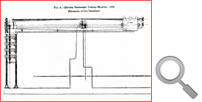
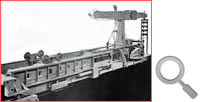
Volume Eleven - Pre-Victorian to the Present Day - some more aspects - Large Testing Machines in South Wales, 1829-1906 . . . The levers are mounted on knife-edged fulera throughout, and care has been taken to arrange all the knife-edges in strict alignment. The machine would test up to loads of 130 tons, and Mr. Williams made experiments with it on riveted joints, with lap joints, with single butt-straps, and with double butt-strap, and also upon iron bolts up to 2 in. square. His records of load are astonishingly high, reaching over 30 tons per square inch on wrought-iron bolts. The author will leave it to others, who know the history of iron in South Wales better than he does, to say whether bolts could be made in South Wales in 1828 giving 30 tons per square inch of strength measured on the original sectional area. But if Mr. Williams reckoned his load upon the fractured sectional area, instead of the original sectional area, there would be no difficulty in accounting for the high results which he obtained. Simple as this machine ay seem, it is proof of true genius in the designer that he adopted those essential principles which have held their own in competition with every other device for three quarters of a century and still continue to hold the field. Fig. 5 shows a plan of the 350-ton machine now working at the Lloyd's Bute Proving House ; Fig. 6 shows an elevation, partly in section, of the steelyard end of the machine, and general views are shown in Figs. 1, 2, and 7.
|
||||||||
| Introduction | |||||||||
| Contents | |||||||||
| Search this site | |||||||||
| Contributions | |||||||||
| Links | |||||||||
| Recent Updates | |||||||||
|
|||||||||
| | volume 11 | chapter 12 | page 090 | << previous page << | index to volume eleven | >> next page >> | | |||||||||
|
|||||||||