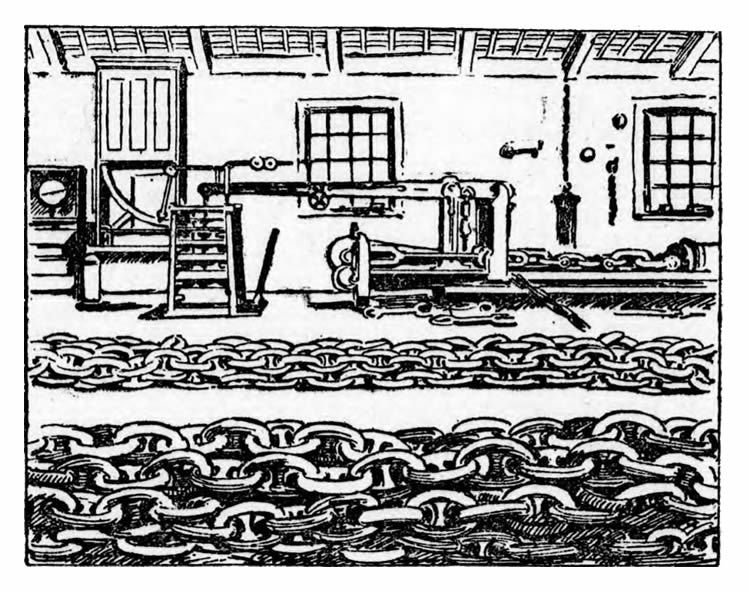
1893 - CHAIN AND ANCHOR TESTING AT CARDIFF. LLOYD'S BUTE PUBLIC PROVING HOUSE.
Out of the whole population of Cardiff, there is probably only a small proportion who know of the existence of Lloyd's Bute Public Proving House, which is situated on the west side of the Glamorganshire Canal, and fewer still are aware of the useful work carried on there. The importance of having cable chains and anchors periodically tested will be conceived by all who possess even the most elementary knowledge of navigation. The parting of a cable at sea frequently leads to the destruction of shipping property, and in too many cases to serious loss of life. A defective anchor produces equally disastrous results, and even on land the weakness of a chain or wire rope has occasionally been responsible for accidents of a distressing nature. It will be admitted, therefore, that a licensed proving house is one of the most useful and absolutely necessary institutions in the industrial and mercantile system of Cardiff and neighbourhood, and that its importance cannot possibly be over-rated.
The Lloyd's Bute Proving House was erected in 1864-5, and established in 1866, for testing chain cables, anchors, &c. It is licensed by the Board of Trade under the Chain, Cables, and Anchors Acts, 1864 to 1874, and inasmuch as Government Departments are always careful to protect the public as far as possible in cases where human life is dependent upon accurate and efficient tests, this fact alone is sufficient evidence that the Bute Proving House is thoroughly equipped for the work which has to perform. It is, indeed, the only licensed house in Wales and the West and South of England, and consequently proves of great benefit to vessels trading from Cardiff or any other port in the Bristol Channel.
The house could not be better situated, for, by means of a steam travelling crane, vessels or lighters in the canal, or railway trucks, which can be brought alongside the works, can be discharged and load direct, the expense of haulage being thus saved. The liberal basis upon which the works have been established has gained for them the recognition, not only of Lloyd's, but of the Bureau Veritas and all other marine insurance societies.
They are fitted up with the most modern plant, including two powerful hydraulic testing machines, which indicate the strain applied by lever and dead-weight, thus ensuring accurate results. The breaking machine, licensed up to 250 tons, is fitted with duplex hydraulic gauges for experimental testing. The tensile machine is licensed to 180 tons, and is fitted with a bed 90ft. long. The hydraulic shears, which is capable of exerting a force of 250 tons, is fitted with gauges which indicate the pressure applied in shearing iron and other metals.
Besides the ordinary testing of chain cables and anchors, every description of experimental testing of iron, steel, &c. to tensile. compressive, and transverse strain, to ascertain their quality is carried out with the greatest possible accuracy, and full reports of each test are supplied. The cables and anchors, many of them of immense size, which lie around the works show that shipowners fully appreciate the facilities which are afforded them to properly equip their vessels but colliery proprietors and contractors do not appear to take so great an advantage of the works as they might. This is possibly due to the fact that the existence of the proving-house, long as it has been established, is not so generally known as it should be. All colliery requisites, such as wire ropes, tram-couplings, draw-bars, &c., and hooks, blocks, sling-crane, and other chains and gear used by contractors and users of machinery generally.
Certificates can be obtained from the works, and in case of accidents afterwards occurring employers will have the knowledge that they have done all in their power to guard against them. The works would not, of course, be complete without a forge and a supply of links of all descriptions, so that repairs to chains can be made without delay. A new system is adopted for blacking. The chains are heated and then passed through a cistern of tar, and afterwards deposited on a grating to dry. This system ensures a thin coating of tar which adheres to the iron as if it were a part of it.
In a district like South Wales, where so much machinery is in operation, the advantages offered by Lloyd's Bute Proving House cannot be over-estimated. The superintendent of the works is Mr. G. W. Penn, a gentleman who possesses a thorough knowledge of the business, and who minutely explained to a representative of the Western Mail the interesting and instructive processes by which the various tests are conducted. - The Western Mail [036] [361] 5th May 1893. |