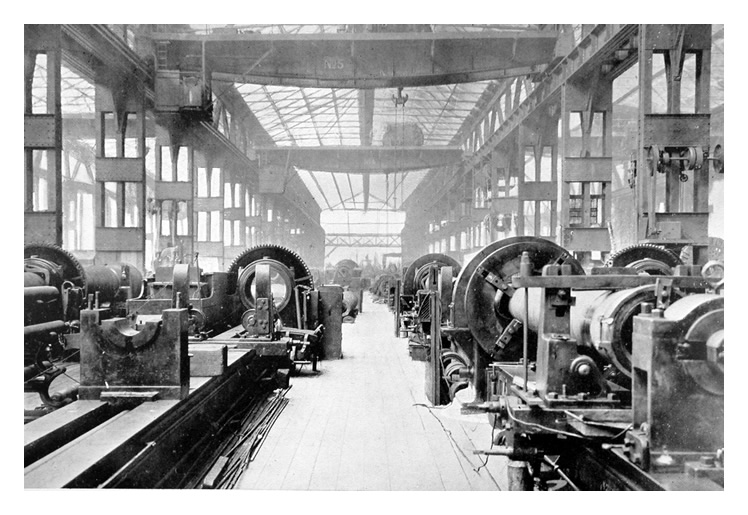
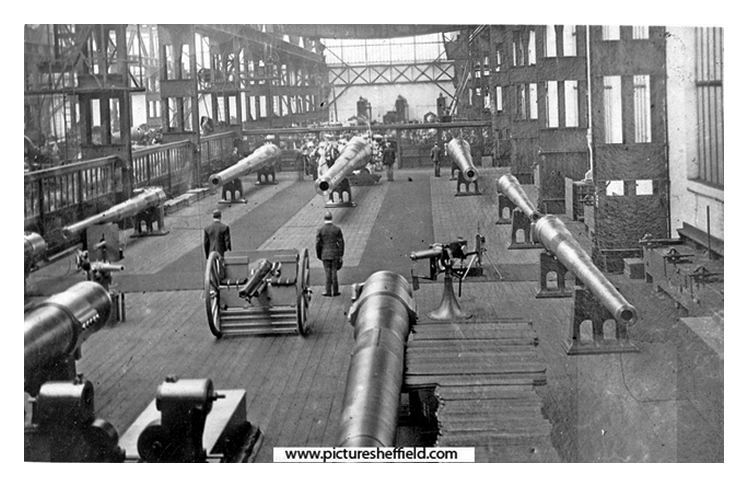
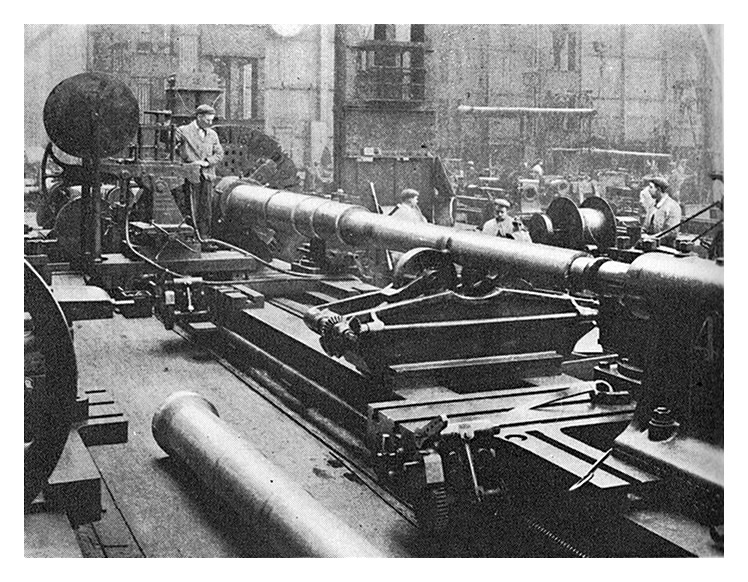
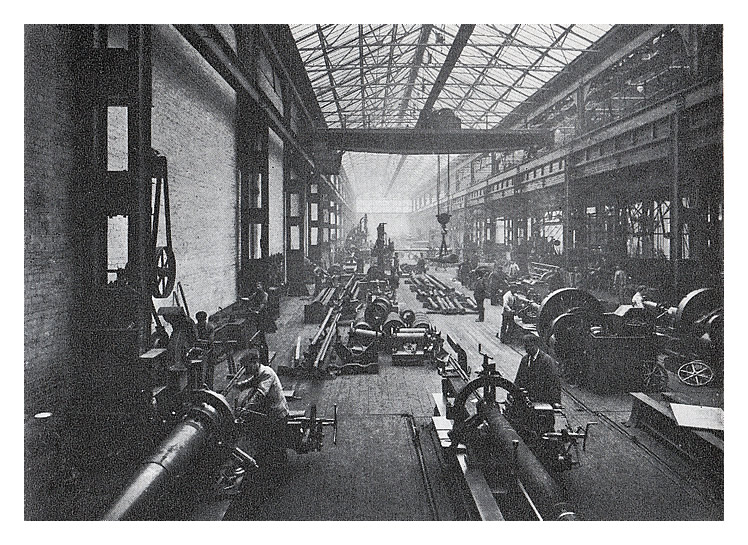
c.1900 - Machinery for winding the miles of reinforcing wire onto the barrels of heavy guns at Vickers, Sheffield, around 1900. [1141]
The Wire-Wound Gun - This is an example of the 'initial tension' system. The wire is wound in layers around an inner tube of steel. Each layer is wound with a different tension of the wire, and each, layer exerts a compression on the layers which are inside of it. The result is that when completed the outer layers are in extension, gradually diminishing to the inner layers, which are in compression ; all within the elastic limit.
As wire can be made of enormous strength (as much as 200,000 pounds per square inch tensile strength), this type of gun is the strongest for the same weight of any yet developed. In the different types of wire-wound guns, the inner tube may be either one piece of steel, or a number of longitudinal bars of special shape like the staves of a barrel gripped together by the wire to form a tube. As narrow bars can be made stronger than one large forging, this 'stave' or 'segmental' wire-wound gun is supposed to represent the highest type of built-up gun and will stand enormous pressure. (35 tons per square inch and more hare been recorded).
The usual way, however, of building up wire-wound guns is to have a solid forging for the tube, stepped at the rear end, the wire being wound only over the parts covering the chamber and the rear end of the rifled bore. The ordinary hoops are shrunk on over the chase, and an outer hoop or hoops, also shrunk on, cover the wire-wound part. [1142]
|