|
|
Penarth Dock, South Wales - the heritage & legacy . . . |
|
|
Penarth Dock, South Wales - the heritage & legacy . . . |
 |
|||||
 |
Volume Twelve - Pre-Victorian to the Present Day - further aspects - The River Ely Iron Ore Wharf . . . The Penydarren locomotive of 1804 broke the brittle iron rails on which it ran, hence, it became clear that a cheap, tough and malleable metal was needed for many engineering applications! The invention of steel, which is fundamentally refined iron, with a reduced carbon content, had significant implications for the entire iron industry since steel is malleable and exhibits superior tensile, flexural and torsional characteristics in comparison to cast or wrought iron. This steel was about 50% stronger than wrought iron!
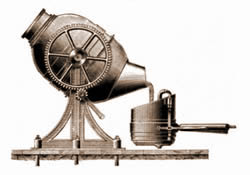
The quality of the steel output from the Bessemer process gradually improved ; the issue being that the local ore contained high levels of phosphorus which rendered it 'hot-short'. The imported Spanish iron ore had a much lower content and was preferred. Almost a decade of experimentation, under the guidance of William Menelaus (1818-1882), resulted in efficient production of steel at Dowlais. Menelaus invited Bessemer to Dowlais to conduct experiments and eventually they succeeded in rolling the first rail without the need of puddling the iron and Mr. Menelaus became known as 'The Celebrated Rail-Maker of Dowlais'. |
||||
| Introduction | |||||
| Contents | |||||
| Search this site | |||||
| Contributions | |||||
| Links | |||||
| Recent Updates | |||||
|
|||||
| | volume 12 | chapter 11 | page 040 | << previous page << | index to volume twelve | >> next page >> | | |||||
|
|||||