|
|
Penarth Dock, South Wales - the heritage & legacy . . . |
|
|
Penarth Dock, South Wales - the heritage & legacy . . . |
 |
|||||
 |
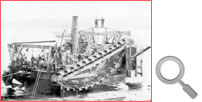
Volume Eight - Pre-Victorian to the present day - more aspects - To dredge the River Ely - 1860's David Barnicoat's excellent research of the 'Briton' is to found within his history of the port of Falmouth: [323] 'Dredging to accommodate the world's largest cruise ships is high on the agenda in 2010 . . . A similar problem faced Falmouth Docks directors in the 1860's when dredging had to be carried out with a steam dredger. The dredger 'Briton' came to Falmouth from South Wales. Her owner Richard Mitchell had used the dredger on various dredging projects in Penarth Docks, Cattewater, Plymouth, Southampton and Swansea. The Dock Company purchased the 'Briton' from Mr. Mitchell in 1863 for the sum of £4,400 which in those days was a considerable amount.
She worked for three years at Falmouth in association with a wooden hopper barge, so it is reasonable to assume the same arrangement was in place during excavation and diversion of the River Ely. I am unsure, however, if she was utilised in the construction of the Penarth Dock. The first steam driven dredger was built in England in 1796 complete with an engine designed by James Watt, but it was found that it was not robust enough. A heavier version was necessary so a larger one of the same design was built in 1804. Meanwhile, Richard Trevithick worked from 1803 on a bucket type steam dredger constructed for use on the River Thames. 'Blazer' was launched in 1806, followed by 'Plymouth' a year later designed and developed by Trevithick adapting the use of his 'high pressure steam engine'. Apparently they were functional but some reports suggest that it was less expensive to use man-power than steam-power. These reports do not state, however, that the forced hard-labour of the convicts detained at Her Majesty's pleasure at Woolwich was the basis for comparison! The principles adopted by Mr. Mitchell were very similar to Mr. Trevithick's designs. |
||||
| Introduction | |||||
| Contents | |||||
| Search this site | |||||
| Contributions | |||||
| Links | |||||
| Recent Updates | |||||
|
|||||
| | volume 08 | chapter 06 | page 140 | << previous page << | index to volume eight | >> next page >> | | |||||
|
|||||