|
|
Penarth Dock, South Wales - the heritage & legacy . . . |
|
|
Penarth Dock, South Wales - the heritage & legacy . . . |
 |
|||||
 |
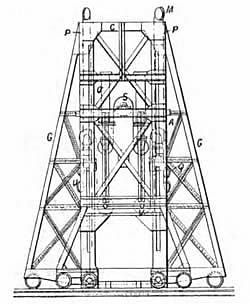
Volume Eleven - Pre-Victorian to the Present Day - some more aspects - Patent Applications by George Taylor, of Penarth, 1883 . . .
A chain is connected to the bracket carrying the sheaves of the hoisting rams, and passes over a pulley at the top of the staith, and has a weight attached to it to counter balance the platform wagon and rams. The loaded wagon enters upon the platform at the upper part of the staith, and being heavier than the counterweights, the platform and wagon descend under the control of a suitable brake, the tipping being effected by arresting the required counter-weights. (Accepted May 12, 1885).
|
||||
| Introduction | |||||
| Contents | |||||
| Search this site | |||||
| Contributions | |||||
| Links | |||||
| Recent Updates | |||||
|
|||||
| | volume 11 | chapter 09 | page 260 | << previous page << | index to volume eleven | >> next page >> | | |||||
|
|||||